
Danbury, CT · Garage Door Service
Openers and Power Outages in Danbury Homes
Danbury's 1950s-2010s housing stock and severe cold climate mean openers fail differently here. Learn what to check before you call for a stuck door.
- Repairs & new doors
- Springs & openers
- Serving 5 nearby communities
Checking It Yourself
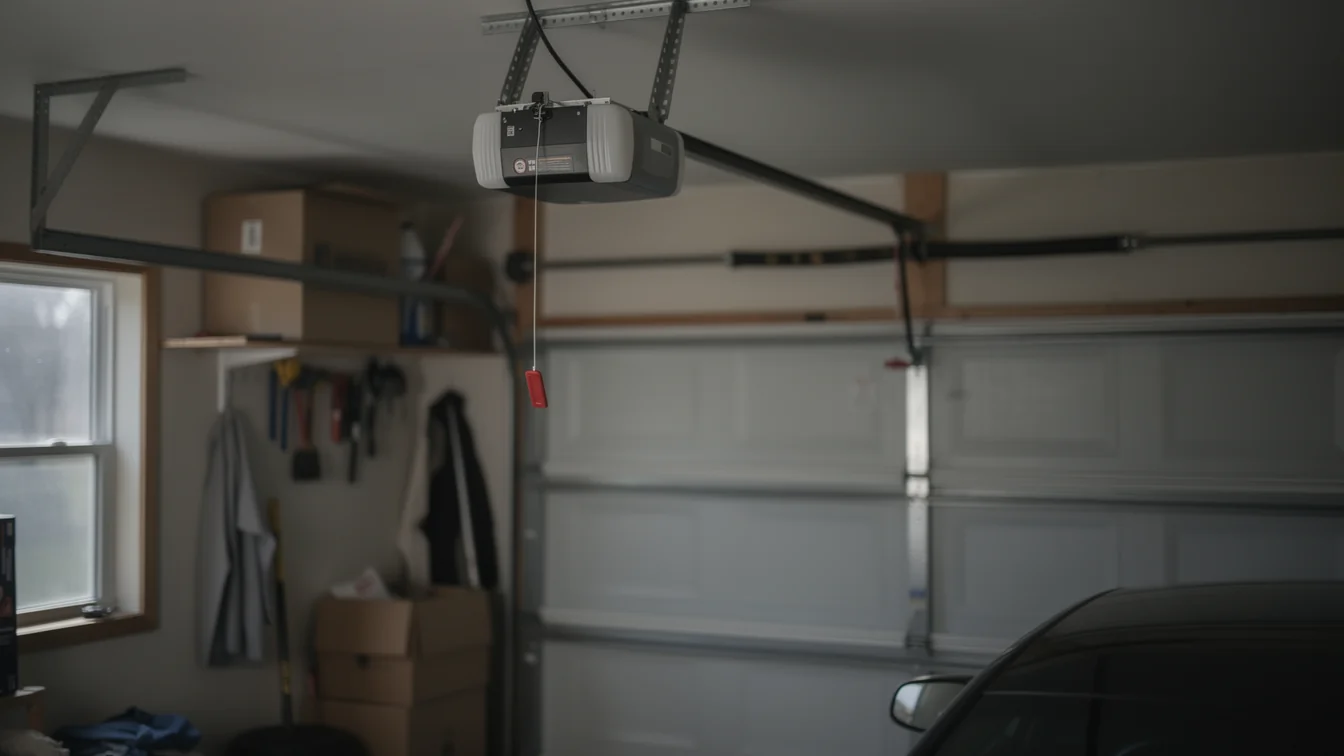
Before you assume the opener is dead, find the manual release cord - the red handle hanging from the trolley on the track. Pull it down and back toward the motor head to disconnect the door from the opener arm. If the door lifts by hand without much resistance, the opener or the power is the issue, not the springs.
Danbury's housing stock runs from 1952 to 2013, with the median build year around 1972. That spread matters here: a lot of openers in this area were swapped out once or twice since the house was built, but the wiring and the wall switch often weren't touched. Check whether your unit has a battery backup box bolted to the motor housing - this became common on newer installs but isn't standard on anything installed before the last decade or so. No battery box means no backup, full stop.
Also check the wall-mounted control. On older setups in this area, that switch is wired directly with no battery pass-through, so a dead circuit there kills the whole system even if the motor head has power elsewhere in the house.
The Common Mistake
The mistake we see most in Danbury is leaving the opener in automatic mode and assuming a stuck door means a broken motor, when it's actually a breaker that tripped during a cold-weather power interruption. People climb a ladder, pop the cover off the opener, and start poking at wiring before checking the panel.
The second mistake is specific to the age of housing here. With a median build year of 1972, a lot of these garages still have the original circuit run, a single dedicated line with no surge protection. A power outage followed by a hard restart - which is common with the grid cycling back on after a cold-climate outage - sends a spike through that old wiring. The opener logic board takes the hit, not the motor. People replace the whole opener when the fix is a new logic board, because nobody checked which half failed.
We'll say this plainly: if your opener is original to a mid-century house in this area, the board is usually the weak point before the motor ever is.
The Problem
Danbury sits in a severe cold climate band. That means winter power interruptions aren't rare occurrences - they're something the local grid deals with every season, and garage doors are one of the few home systems that fail completely, not partially, when the power drops. A furnace keeps some heat from stored thermal mass. A garage door with no manual override knowledge just sits shut.
The age of the housing compounds this. Most of the stock here went up in the 1960s and 70s, and those garages were built with single-car or narrow double openings and openers sized for that era's lighter doors. When a cold-weather outage hits and the door won't budge, people force the manual release under load, which can bend the trolley arm or snap the release cord. We've seen it enough to call it a pattern, not a one-off.
One honest limit: if your opener logic board is already failing before the outage, a battery backup unit won't save it. Backup power keeps a healthy opener running through a cut. It doesn't repair a board that was already on its way out.
What Local Conditions Do
Across the roughly 95,439 households in this service area, about 65,911 are owner-occupied houses - the kind with an attached or detached garage, not a shared lot. That's a lot of individual openers, most installed into housing built between 1952 and 2013, with the heaviest concentration from the 1960s and 70s.
The median household income here, around $143,864, means battery backup openers are a realistic upgrade for a lot of homeowners in this area, not a luxury add-on. We mention it because the fix for recurring cold-climate power outages isn't a thicker door or better weatherstripping - it's power redundancy at the opener itself.
If you're deciding whether to add a backup unit or just learn where your manual release is, the second one costs nothing and works regardless of what else you do. We'd start there before spending on hardware.
Frequently asked questions
Why does my garage door opener stop working every time the power goes out?
Most openers built before the last decade have no battery backup, so a power outage shuts them down completely. In Danbury's severe cold climate, winter outages happen often enough that this becomes a recurring problem rather than a one-time inconvenience. A battery backup box fixes it going forward, but it won't fix a unit whose board already failed.
Is it safe to force the manual release when the door won't open?
You can pull the release cord, but don't force it if the door won't lift by hand afterward - that usually means a spring issue, not a power issue, and forcing it risks bending the trolley arm or snapping the cord. If the door still feels heavy after disconnecting from the opener, stop and call it in.
My house was built in the 1960s - does that affect my opener?
It can. A lot of openers in this area have been replaced once since the house was built, but the original wiring and wall switch often haven't. That older wiring has no surge protection, so a power outage followed by a hard restart can damage the opener's logic board even when the motor itself is fine.
Related garage door services in Danbury
More garage door guides
Book garage door service in Danbury
Call now or request a quote - tell us what the door is doing and where you are.