
Danbury, CT · Garage Door Service
Garage Door Service for Danbury's 1960s-70s Housing Stock
Danbury homes built mostly 1960s-70s face cold-climate spring and track wear. Local service for the housing stock and winters actually found here.
- Repairs & new doors
- Springs & openers
- Serving 5 nearby communities
Why This Fails Locally
Most of the housing around Danbury went up between 1952 and 2013, with the median build year landing in 1972, and the bulk of it clustered in that 1960s-70s wave across the 28 named areas that make up this market. That matters because a garage door installed in that window was built for a different set of expectations than today's doors, and thirty-plus-year-old torsion springs, steel rollers, and single-layer panels are still common on these houses.
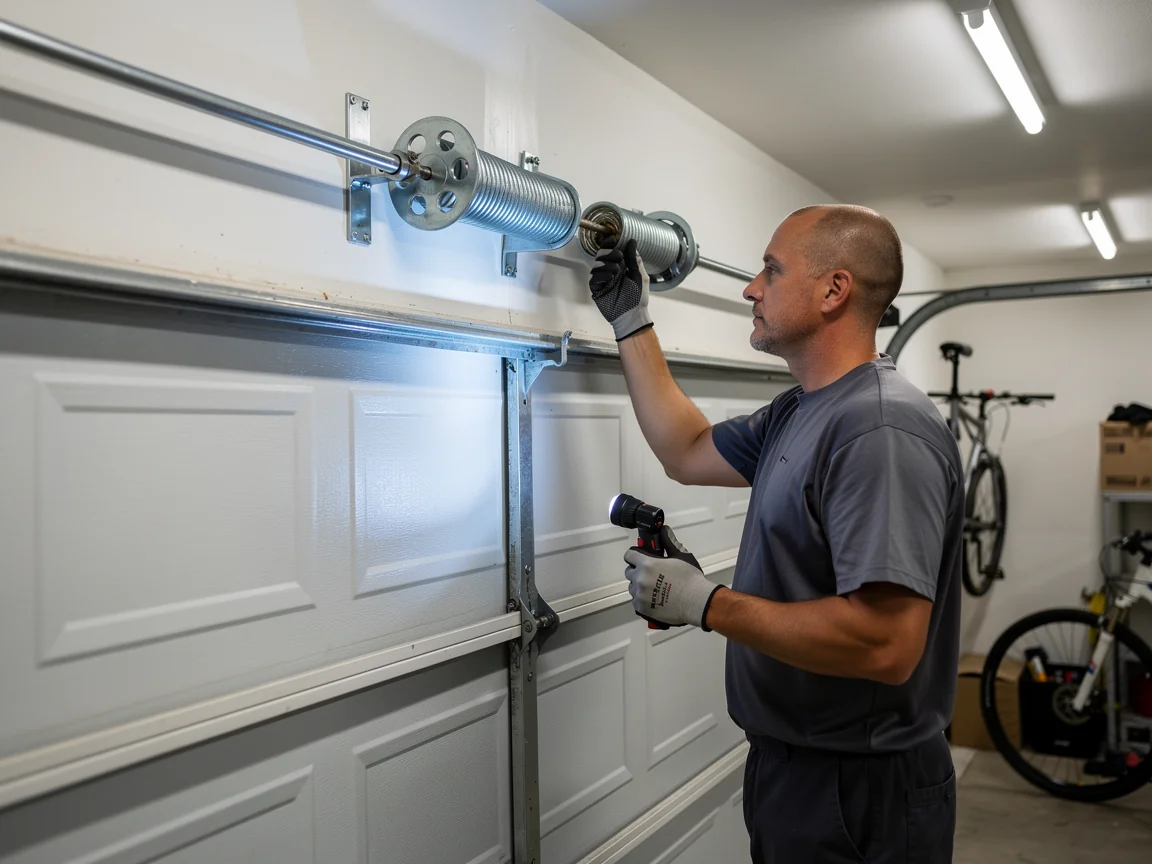
Pair that housing age with a cold, severe climate band, and you get a specific failure pattern: steel contracts hard in deep cold, lubricant thickens, and a spring that was already fatigued from four decades of cycles finally lets go on the first single-digit morning of the season. This isn't a general garage door problem - it's what happens when 1970s hardware meets a Connecticut winter.
We see the same thing on houses from Bethel out through Ridgefield and New Fairfield, because the building era and the weather don't change much across that stretch. The fix isn't exotic. It's matching the repair to the actual age and type of hardware already on the house, not whatever the newest catalog part happens to be.
What You Pay
We don't have a published price list to quote here, and giving you a number without seeing the door would be a guess dressed up as a fact. What we can tell you is what drives the cost on a house like the ones common in this area: whether the spring size matches a door built in the 1960s-70s era or has already been swapped for a mismatched replacement, whether the opener is original to the house, and how much the cold has done to the hardware before anyone looked at it.
Median household income across the service area runs close to $143,864, and with roughly 65,911 owner-occupied houses out of 95,439 households total, a lot of the work we do is straightforward torsion spring and roller replacement rather than full door swaps. That's typically the more affordable path when the door itself is sound and it's the moving parts that gave out.
Ask for a number over the phone before anyone's seen the door and treat it as a placeholder, not a quote. The honest answer is that we tell you what you're paying for after we're standing in front of it.
What You Are Seeing
If the door is slow to open on a cold morning, or the opener strains and reverses partway up, that's usually a spring that's lost tension - common on doors original to houses built in that 1952-2013 window, especially the ones closer to the 1972 median. You might also notice a loud bang from the garage followed by the door refusing to move at all. That's a torsion spring that's finished, not something to force past with the opener.
Uneven movement - one side dropping faster than the other, or the door racking sideways in the track - points to a cable or roller issue rather than the spring itself. On the older steel-roller doors still common in this area, that wear shows up faster once the cold sets in, because the metal doesn't flex the way it did when the hardware was new.
A door that opens fine but won't seal tight at the bottom, letting cold air into the garage, is a weatherstrip and alignment problem rather than a mechanical failure - worth fixing in this climate, but not an emergency.
What Can Go Wrong
A torsion spring under tension is not a DIY part, full stop - this is the one limitation we'll state plainly. If you've already tried to loosen or swap a spring yourself and it's wound tight, stop and call, because that's the injury that sends people to the ER, not an inconvenience.
Beyond that, the bigger risk in a cold-severe climate is deferring a repair past the point where it's still a repair. A cracked panel or a track that's slightly bent in October can usually be fixed. The same issue left through a full winter of freeze-thaw cycles often means the whole section needs replacing instead, because the cold finishes what the first crack started.
On houses from the 1960s-70s wave, we also see owners replace a spring without checking the drum or cable it's paired with, which just moves the failure a few months down the road. The honest move is to fix the whole worn set at once rather than patch one part and get called back out in February.
Frequently asked questions
Why do garage door springs fail more in winter here?
Houses in this area were mostly built between 1952 and 2013, with most stock from the 1960s-70s, and that hardware is now decades old. Combine aging steel with this region's cold-severe winters and the metal contracts, lubricant stiffens, and a spring already fatigued from years of cycles is more likely to snap on a hard-freeze morning than in mild weather.
Is it worth repairing an old door or replacing it?
Depends what's failed. If it's a spring, cable, or roller on a door that's otherwise sound, repair is usually the more affordable path. If the panels are cracked from freeze-thaw cycles or the track is bent beyond simple realignment, replacement tends to cost less over time than repeated patch repairs.
Do you service areas outside Danbury itself?
We work across the surrounding area, including towns like Bethel, Ridgefield, New Fairfield, Brookfield, and Newtown, which share the same housing era and climate conditions that drive most of the repair calls we get.
Related services
Related guides
By Neighborhood
Garage Door Service across the Danbury area
We also handle garage door service in these Danbury-area suburbs.
Book garage door service in Danbury
Call now or request a quote - tell us what the door is doing and where you are.