
Danbury, CT · Garage Door Service
Garage Door Service for Newtown's 1960s Housing Stock
Newtown homes mostly date to the early 1960s, which means original extension-spring hardware. Danbury Garage Door Pros drives out 9 miles to fix it.
- Repairs & new doors
- Springs & openers
- Serving 5 nearby communities
How Long It Takes
The most common call we get out of Newtown isn't a dead opener, it's a door that's come off one of its tracks because the extension springs over the horizontal rail have stretched past their rated cycle count. Houses here went up mostly around 1961, a good decade before torsion-bar hardware became the standard supply on new construction across the rest of the wider service area, where the median build year runs closer to 1972. That gap matters: a torsion job and an extension-spring job are different repairs with different parts on the truck.
We come from Danbury, about 9 miles off. That's not a same-block response, and we won't pretend it is - there's no local branch sitting in Newtown, no depot around the corner. What it does mean is a drive time that's short enough that we're not squeezing a Newtown call between two others on the far side of the territory. If your spring's already snapped and the door won't budge, say so when you call; that changes which truck gets sent and what's loaded on it.
How to Book
Call and tell us what the door is doing - won't open, opens partway and reverses, makes a bang when it goes up. If you know roughly when the house was built, mention that too. On a house from the early 1960s, that single detail usually tells us more about what's wrong than a description of the symptom does, because it points straight at the hardware generation.
We don't run a Newtown office, so there's no walk-in counter and no same-hour guarantee we can make good on from 9 miles away. What we can do is get a truck stocked for the kind of hardware this town actually has, rather than showing up with parts built for a 1980s torsion setup and discovering the track mounts don't match. You can see the general coverage for this part of the county on the area page, and the full rundown of what the Danbury shop handles day to day is on our main service page.
Parts We Carry
For a town built mostly in the 1961 window, the parts that actually get used are extension springs rated for residential 7-foot and 8-foot doors, replacement pulleys and safety cables for those spring systems, and steel rollers to replace the originals that have worn their stems down. A lot of these doors were never upgraded to torsion bar, so we carry the extension hardware specifically instead of assuming torsion is the default, which is the mistake a lot of trucks make when they're set up for the newer end of the service area's housing.
We also keep weatherstrip and bottom seal stock sized for the older steel panel widths common on doors from this era, since cold-climate swelling and shrinking chews through seals faster than people expect. One honest limit: specialty wood-panel replacements and discontinued original panel profiles from the early 1960s aren't something we stock - those are special-order, and lead time runs longer than a standard repair.
What You Pay
We don't have a posted price list for Newtown specifically, and we're not going to invent one here. What we can say is that extension-spring repairs on an early-1960s door are a different job, with different labor, than a torsion conversion or a full opener swap - and pricing follows the job, not the town.
Newtown's median household income, at roughly $161,000, runs well above the $143,864 median across the wider service area, which is worth knowing only in that it shapes what kind of replacement options homeowners here tend to ask for - insulated steel and composite doors come up more than bare single-layer panels. That's a pattern we notice, not a quote. Call for an actual number once we know what's actually wrong with your door.
What You Are Seeing
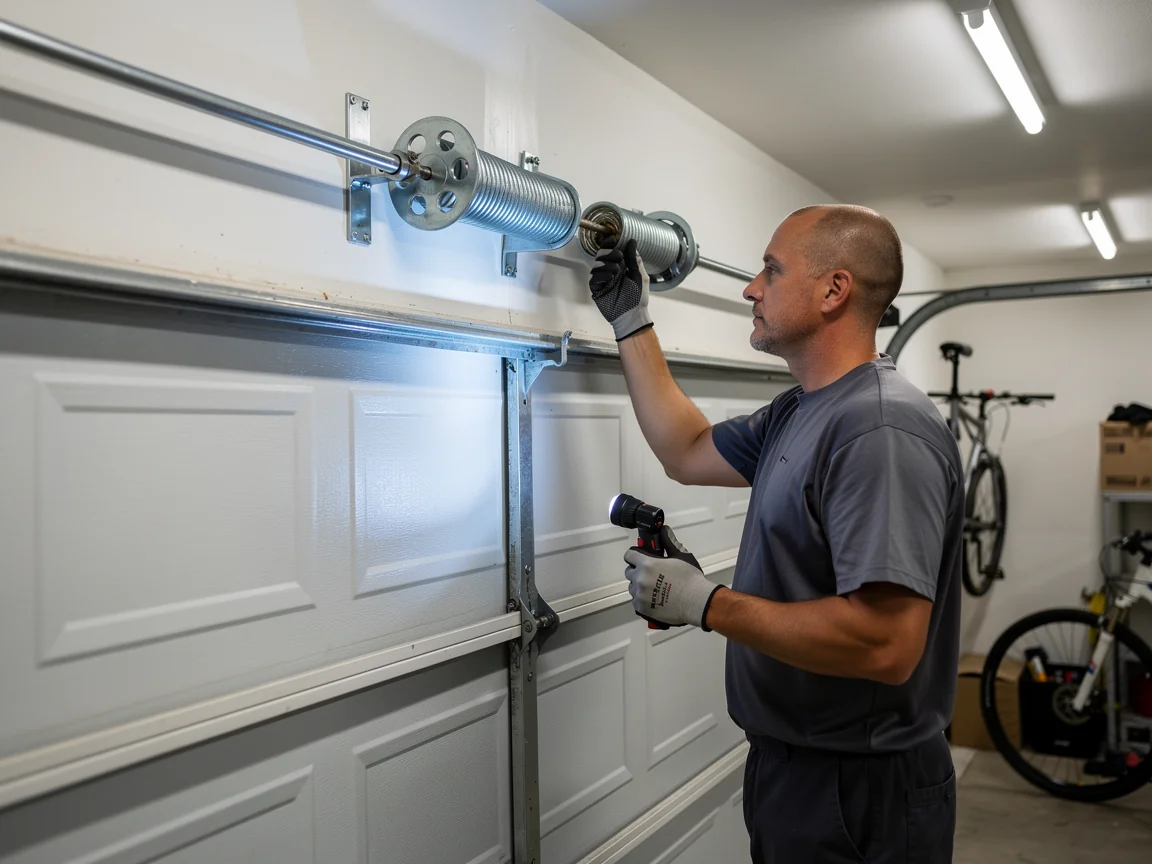
If your door is original to the house, it's an early-1960s build riding on extension springs, steel rollers, and hardware that was never rated for the cycle counts a door sees sixty years later. The symptom list runs predictable: a door that slams down the last foot of travel because the spring tension has dropped, cables that fray where they wrap the drum, or a door that's visibly racked because one side's spring gave out before the other.
Cold-climate severity in this region adds another layer - steel contracts, lubricant stiffens, and a door that worked fine in September can bind hard in January. None of that is unique to one house; it's what the housing stock as a whole is doing now that it's past the half-century mark. With about 698 households in Newtown's footprint, that's a smaller pocket of this pattern than Danbury's broader base, but the pattern itself is the same.
Why This Fails Locally
The failure isn't random - it's the math of a door built for maybe 10,000 cycles sitting at 20,000 or more, on hardware nobody's made in the original spec for years. Extension springs lose tension gradually, so the door doesn't stop working all at once; it gets a little harder to lift every season until one day a cable snaps or a spring lets go entirely, usually in cold weather when the steel's already stiff.
The fix that actually lasts in a lot of these Newtown houses is a full torsion conversion rather than a like-for-like extension-spring replacement, since torsion systems don't carry the same open-cable safety risk and hold tension more evenly over the door's width. That's a bigger job and costs more up front. We'll tell you when a straight repair is the honest call and when it's just delaying a job you'll pay for twice. See the area page for how this fits into the rest of what we cover out of Danbury.
Frequently asked questions
Why does my Newtown garage door use different springs than my neighbor's new opener setup?
Depends on when the door was installed. Newtown's housing is mostly original to around 1961, when extension springs mounted over the horizontal track were standard. Torsion-bar systems didn't become the common new-construction default until later, closer to the 1970s stock you see elsewhere in the wider service area, so two houses a few decades apart can have entirely different hardware.
Do you have a branch in Newtown?
No. We work out of Danbury, about 9 miles from Newtown, and drive out for calls rather than staffing a local office here. That means no walk-in counter in town, but it also means the truck is stocked before it leaves, based on what you describe over the phone.
Is it worth repairing an original 1960s door or should I replace it?
If the panels are sound and it's just springs, cables, or rollers, repair usually makes sense. If the door is racked, the panels are rusted through, or it's an extension-spring system that keeps failing, a torsion conversion or full replacement often costs less over time than repeated patch repairs. We'll tell you which situation you're in before we quote anything.
Book garage door service in Danbury
Call now or request a quote - tell us what the door is doing and where you are.